



,,Die Leute erschweren es sich und andern. Doch,“ sagte er, „man muß sich darein resignieren wie ein Reisender, der über einen Berg muß; freilich, wäre der Berg nicht da, so wär der Weg viel bequemer und kürzer; er ist nun aber da, und man soll hinüber!”
“People make it hard for themselves and for others. Yet,” he said, “one must resign oneself to it like a traveler who has to go over a mountain; admittedly, if the mountain weren’t there, the path would be far more convenient and shorter; but it is there now, and one shall cross over it!”
-Johann Wolfgang von Goethe Die Leiden des jungen Werthers (The Sorrows of Young Werther)
Less Than Optimal Reactions to Feminism and the Left
There has been a wide range of responses and reactions against various iterations and waves of feminism. While many of these responses have been quite laudable, many have been most unsavory in their own uniquely peculiar and pernicious ways. Some of the more undesirable phenomena includes figures like Andrew Tate, as well as the so-called MGTOW movement, which encourages men to be overtly hostile to women and withdraw any interest in women categorically. Consider much of the overt misogyny expressed by figures like Nick Fuentes and Matt Evans—who goes by that stupid moniker “Beardson Beardly.” These and other figures routinely engage in rhetoric so vitriolic and ridiculous it defies credulity. Nick Fuentes recently asserted that all women—not just those who hate white men, luxuriate in the sick thrill of abortions, and are utterly unfit as prospective wives or even girlfriends—should be condemned to “rape camps for breeding.” Evans is also a uniquely grotesque figure with his repulsive appearance and manlet stature, compounded by remarks—both unsavory and ridiculous—that only worsen relations between men and women. Given these and a myriad other liabilities from these two and other figures as well, one can only conclude two possible explanations. Either they are part of a black propaganda campaign or nefarious interests have propelled them to influence they do not deserve as part of the “nut-picking” method of discreditation. By either alternative theory, media and social media conglomerates boost unsavory figures in order to taint, discredit, and harm meaningful opposition to feminism and other platforms in left-wing ideology.

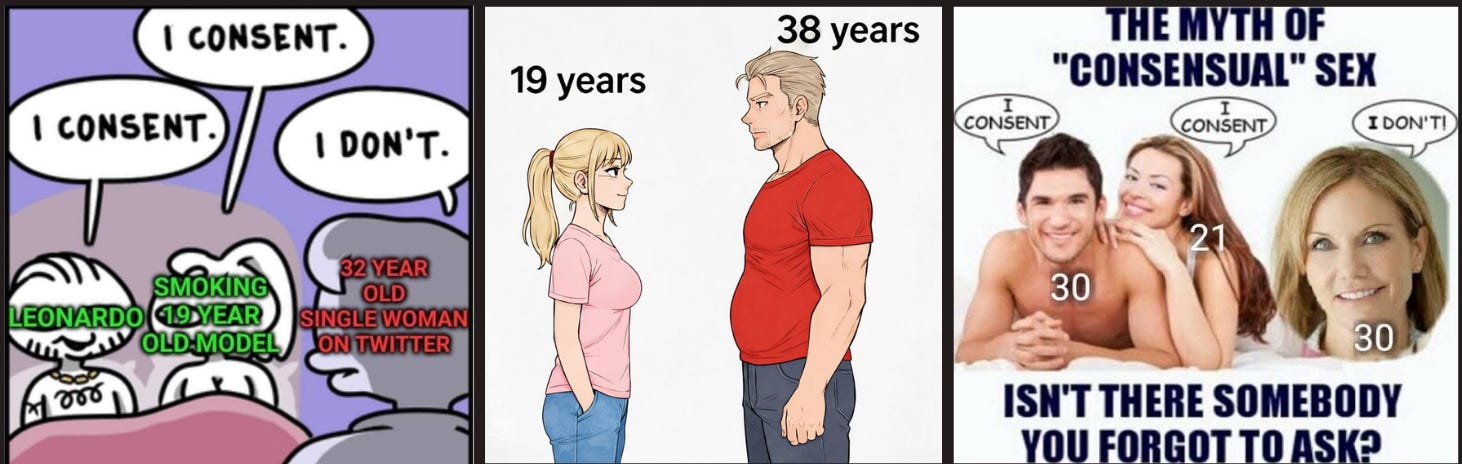
This essay concerns one particularly disconcerting outgrowth from the number of responses to feminism: a trend whereby a certain contingent of anti-feminists condone age-inappropriate relationships between older men and younger women, often much younger women. Examples of this phenomenon include a meme altering a famous Stonetoss cartoon, depicting Leonardo DiCaprio bedding yet another young woman in her early twenties, with both stating “I consent” in one panel, juxtaposed with a second panel of a woman in her thirties, a typical feminist shrew, countering “I do not consent.” This is a direct continuation of one of the worst strains in Amiland that celebrates and condones Hugh Hefner and others procuring and corrupting the most desirable white women, quite literally models, actresses and centerfold models. Memes, images, and other expressions in social media express approval of Bill Belichick having a sexual relationship with a 20-something beauty queen, Jordan Hudson. Other instances condone Tobey MacGuire (50) “dating” model and influencer Mishka Silva (21), as well as general approval of Anthony Kiedis (63) having a romance with Eileen Kelly, aged 30.

Interestingly, many such expressions trot out the tired old chestnut that these people are consenting adults, and thus such matters are of no concern to anyone but those individuals who engage in such behavior directly, as if the actions of others, most particularly famous celebrities, have no influence or impact on society, standards, or morals. Unfortunately, the examples of such fare that can only be derided as “manosphere slop” is quite pervasive. Even worse, such materials often not only drive engagement, but often do so with overwhelming approval and support by certain contingents of men.
Dubious Outcomes and Motives
Many foundational texts and videos encourage young men to undergo what has been described during their 20s as “the grind,” focusing on self-improvement and delaying serious relationships until the mid to late 30s, after someone is established in career and socio-economic status. While the emphasis on self-improvement is commendable, the second prong is not. During this period, young men are advised to categorically forego serious relationships with women. In lieu of any serious relationship, many of these gurus recommend “plate-spinning,” that is seeking casual sex and non-exclusive hook-up partners. According to this “philosophy,” only from one’s mid thirties or later should a man even consider the prospect of marriage, let alone a serious, long-term relationship. Rollo Tomassi, better known as “the rationale male,” even cites Aristotle in support of this model:
Therefore, it is fitting for the women to be married at about the age of eighteen and the men at thirty-seven or a little before—for that will give long enough for the union to take place with their bodily vigor at its prime and for it to arrive with a convenient coincidence of dates at the time when procreation ceases.
— Aristotle, Politics, Book 7, section 1335a
There are three important, critical qualifiers and limitations to this recommendation. First, only a small segment of young men are capable of playing the field in this way. As will be demonstrated, in the context of American college life, that ability is largely limited to fraternity men. Because of this and because of the religious and moral convictions of large numbers of men opposed to feminism and the sexual utopia—or rather dystopia—articulated by F. Roger Devlin, a variant of this scheme retains the “grind” aspect, but either advises young men to abstain from “plate-spinning,” or concludes that such prospects are unlikely to succeed. In addition to objections on religious or moral convictions, others are led to another dire assessment. Many conclude that the field of women in the sexual marketplace is in such a dire state that even “plate spinning” is either not possible or presents difficulties of exceeding severity for a critical mass of young men, thus rendering the “plate spinning” scheme infeasible. Finally, these sorts of utterances have yielded to the slippery slope phenomenon, as the same rationale is used to justify pairings with men in their late forties and even their fifties.

As will be demonstrated in this essay, this phenomenon is both harmful and counterproductive, to both society and the individual, and even hurts many (but not all) of the men such messaging is targeted at. This trend further exacerbates the dire state of the sexual marketplace, encourages and condones hypergamous and even mercenary, gold-digging tendencies in women, and fosters dysfunction, neuroticism, and discord in both men and women.
Much of this is in reaction to hypergamous tendencies that define female sexuality, particularly in the modern age. Encouraging men in their 30s and 40s to marry younger women is founded in equal or greater part on hypogamy, a counterpart to female tendencies to hypergamy. While hypergamy is a key, defining component of female sexuality, it is perhaps best known to readers of this publication from Devlin’s seminal tract Sexual Utopia in Power.
Because of this notoriety and association with a natural enemy of the left, there have been attempts to discredit, minimize, and even stigmatize any discussion of the concept. It nonetheless finds itself in more mainstream writing, even from those of a leftist persuasion. Citing Marcia C. Inhorn, a professor of anthropology, Daniel C. Cox describes hypergamy not as a phenomenon rooted in evolutionary psychology, which it undoubtedly is, but rather asserts that “mainstream cultural tradition has encouraged women to engage in hypergamy.” Inhorn further describes hypergamy as the tendency for women to “marrying up to a slightly older man, somebody who’s more career advanced, makes more money.” In complementary fashion, Inhorn describes hypogamy as the tendency for men to “marrying someone younger, less well off, and less academically accomplished.” It should be noted that the analysis provided by Cox discounts evolutionary psychology entirely, attributing these tendencies exclusively to “social norms.” That in turn leads Cox and so many others to utterly wrong conclusions, asserting that women do not reject men out of hypergamy, but rather the opposite:
Those norms are still so ingrained that as more women have made advances at school and work, many men have held it against them. That women’s hard-earned achievements disadvantage them romantically is a dark irony.
Most readers sense this is an utterly absurd statement, as that assertion is refuted at further length below. The predicament faced by most college aged and professional women derives from female hypergamy, not male hypogamy.
This, however, does not validate or excuse the sorts of inappropriate age-gaps recommended by certain circles. While advancing the idea that older men should pair up with (much) younger women at scale do have some basis in the complimentary phenomena of hypergamy in women and hypogamy in men, the dysfunction and harm emanating from these ideas far outweigh any utility or merit derived from this foundational basis.

One of the biggest drawbacks of this phenomenon is that such a scheme worsens and exacerbates the imbalance that already exists in the sexual marketplace, particularly to the extent it becomes a sociological and cultural trend exhibited at scale. Readers are directed to the explanation set forth in “Culture and the Sexual Marketplace.” A healthy sexual and dating marketplace targets a roughly one-to-one ratio of women of reproductive age in the dating pool for every corresponding male counterpart. When that ratio is placed out of balance with a higher ratio of men to available or suitable women, the costs, for lack of a better term, associated with the sexual marketplace go up. As set forth in “Culture and the Sexual Marketplace,” the term “Higher cost. . . signifies the increased competition that occurs between males when there is a smaller pool of suitable female counterparts, as well as the extra time, effort, and money expended in finding a companion in a dating pool characterized by diminished supply and increased competition among male peers.” The “higher cost” imposed on men “is expressed in many different ways, including greater time and effort invested in social gatherings to find a female companion, lesser odds and more time frequenting coffee shops and other venues that present the possibility of a chance encounter, fewer suitable women on dating applications with more men vying for their attention, and so on.” Any number of cultural and sociological trends which render women less suitable as companions, or increase the competition among men for the remaining pool of women worsen these higher “costs” associated with sex, dating, and the search for a suitable companion. Such nefarious elements can include the normalization of promiscuous and even hyper-promiscuous behavior in women, the normalization and even celebration of bisexuality and lesbianism, the transgender menace, and much more besides.
Worsening the Sexual Marketplace
As was contemplated in “Culture and the Sexual Marketplace,” imagine a small, self-contained pool of 5000 young men and 5000 young women at an imaginary college town. This mental exercise helps conceptualize this fundamental precept. That baseline pool of 5000 women to a corresponding subset of 5000 men is deduced by each contingent of women rendered undesirable by appalling and destructive trends in society and culture. The notion that the transgender menace is trite is repudiated by the consideration that greater numbers of young women have been susceptible to this social contagion than have men. If even two percent of women are seduced by such utter madness, that pool of 5,000 goes down to 4900. Those women, often the most desirable, who dabble in escort work or create profiles on sugar-daddy websites deduct another five, ten, fifteen percent or higher. Significantly, many of these “sugar-daddy” arrangements involve wealthy married men, as tolerating let alone condoning such mercenary gold-digging has also prompted many such men to divorce their wives (and often mothers of their children). Then add the sorority sluts who are effectively groupies for frat bros and so-called “student” athletes. And so on and so forth. When these and other harmful trends are compounded, that baseline pool of 5000 is quickly reduced by half or more, with a disproportionate number of the most alluring and attractive subtracted from that pool of young women.
Crucially, normalizing and even condoning young women to date and even marry older men further exacerbates this imbalance in the sexual marketplace, both as a negative influence on women and by raising the “costs” experienced by men in the sex and dating game by way of increased and often unfair competition. This becomes especially clear when one considers that older men typically have more resources than the age-appropriate counterparts that young women should be dating and taking a romantic interest in.
This simply worsens and compounds an already daunting problem faced by many young men who do not hail from the privilege enjoyed by the upper-middle and upper classes, and even some who do have such a background, but do not fit into the vapid gestalt of normie, mainstream American youth. For quite sometime America has had and continues to have a “rich kid problem,” as does Britain and Europe under the foot of American influence and hegemony. In addition to the princess complex, whereby affluent, mostly suburban white young women are spoiled and coddled first by their “daddies” and then soon their male counterparts within a certain radius, both higher education in the United States and American society more broadly have a “frat boy” problem as much as a “rich kid” or even “princess problem.”
As originally set forth in “The Rating and Dating Complex,” fraternities have been gaming the social, dating, and sex game on campus, and they have been doing so for over a century. The manner in which they have been doing this should have sparked an open revolt by “unaffiliated men,” and indeed the sort of revolt that even the most transparent propagandist would blush to describe as “mostly peaceful.” Fraternity houses host parties—and most importantly, parties serving alcohol1—whereby both sorority women and select unaffiliated women are invited, but “unaffiliated men” are not. Jana Matthews, like Willard Wallace and others before her, describes it thusly. As “fraternities exclude potential competitors from their parties,”—that is, by excluding unaffiliated men or even men from certain disfavored fraternities—they “further manipulate the sex ratio in their favor by opening their party doors to unaffiliated women students and multiple groups of sorority women.” This gaming of the sex dynamic combined with “no alcohol” policies in practically all other social contexts on campus “keeps fraternity row as the de facto campus party headquarters.” Parties, social consensus, along with fixation on status explain why college women, almost monolithically, gravitate to such an obnoxious and juvenile phenomenon as the frat bro douchebag.2
A more critical review and analysis of articles on this matter, such as the infamous New York Times article discussed and analyzed several times before by this author as well as Matthews and Cox utterly discredits and impugns the notion that women face an unfavorable ratio of men to women, insofar as women typically constrain the pool of men by an estrogen-distorted lens. Indeed, the appeal of fraternity men may be mystifying to some. Consider, among other things, the propensity to wear baseball caps backward as well as the absurdity of paying tens of thousands of dollars for others to be one’s friend. Fixations on booze, sexual profligacy, and the bread-and-circus distractions attendant to a school’s football or basketball team further define an ethos so utterly juvenile and boorish. Indeed, the Greek system—fraternities in particular--is antithetical to any proper understanding of what it means to be “collegiate.” This sociological phenomenon has tainted and sullied what is crudely palmed off as an “academic environment,” as its uniquely pernicious character is embodied in a constellation of other lamentable portents of American Unkultur: foremost among them, Barstool Sports, although there are oh so many others.
These circumstances are even more baffling given the performative theater about wanting respect, concerns about “date rape,” and not being made a sex object (before quickly objectifying themselves so very quickly). These are the sorts that a critical mass of college women are little more than groupies for. As hard as it may be to believe, young college women are extremely beholden to young men in fraternities, and are so because of social gatherings—women love parties!—and because of status. Encouraging men in their thirties and forties to make significant incursions on the pool of young women in their 20s and even of-age teenagers out of high school only exacerbates this unlevel playing field that is already well beyond the tipping point.
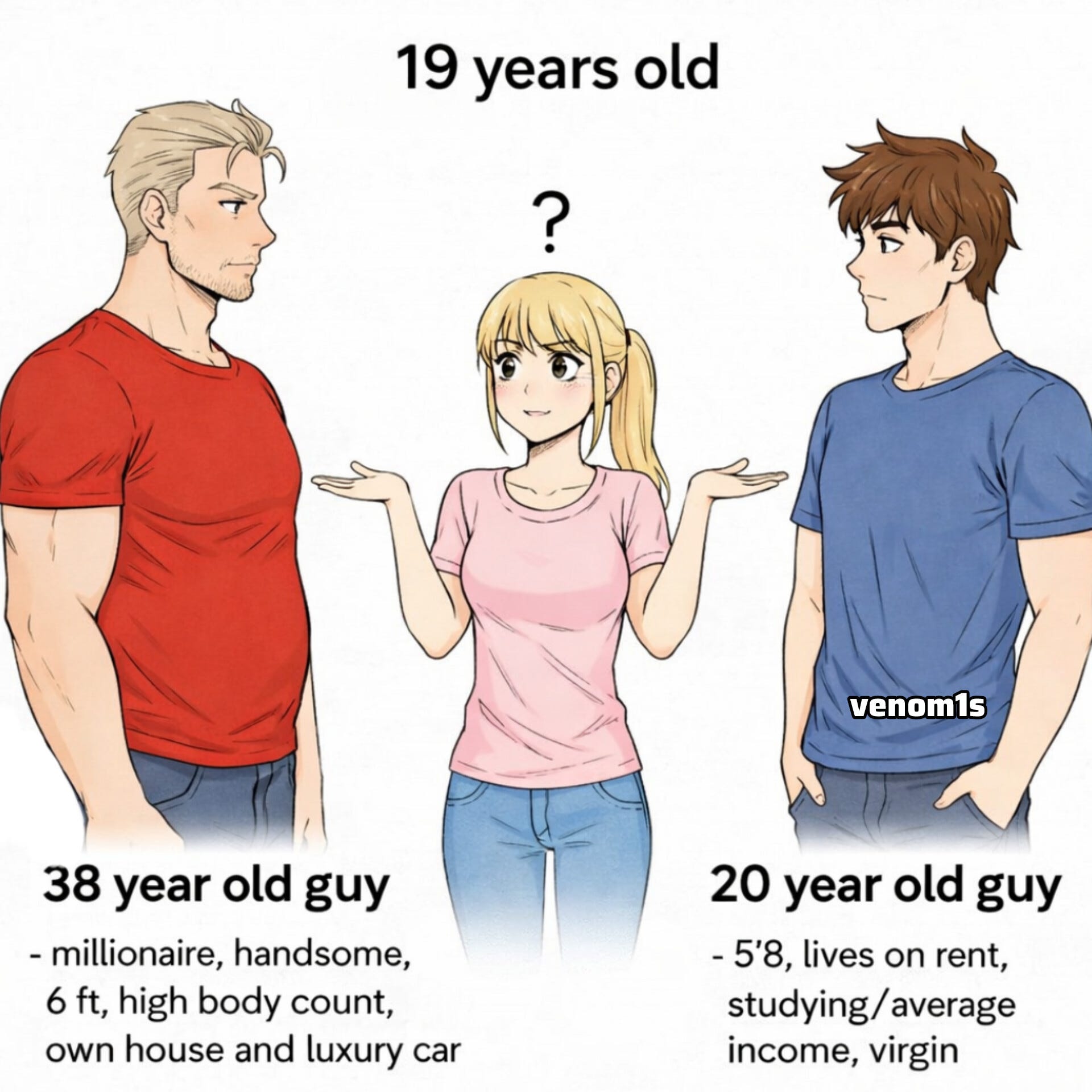
In addition to a target of a one-to-one ratio between men and women in the sexual marketplace, society must also foster social standards whereby young men and women desire each other romantically and sexually during young adulthood. A society must foster and promulgate a sexual marketplace and equilibrium consisting of young men and women who take a sexual and romantic interest in one another with the added social norm and expectation that men and women invest in each other while young. This deters mercenary, gold-digging behavior by women and optimizes the ability of both sexes to maximize their human potential by enjoying the essential advantages of companionship and intimacy when it matters the most. These social norms and standards are mutually beneficial to both sexes. As elaborated in greater detail below, when young women are encouraged to invest in young men as they seek to build their lives, the young men have an easier time succeeding in their academic or other endeavors envisaged to find a meaningful station and place in the world. For women, it affords them a companion that is age appropriate, and avoids the offsetting disadvantages of copulating with older men who are often not as physically attractive and who are not in their physical prime. The oxytocin and other hormones that are released in such optimal pair-bonding scenarios are far more conducive to long-term relationships and even marriage—successful, enduring marriages that avoid the pitfalls of divorce and infidelity.
Social Status and Social Proof: The Key Driver to Sexual Attraction in the Female Mind.
Aside from worsening the state of the sexual marketplace, these ideas are neither helpful nor advisable to young men. Nor are they reasonable. To the extent a variant of “the grind” strategy calls not only for eschewing any prospect of a serious relationship but also prolonged periods of celibacy (voluntary or otherwise), a critical oversight in this absurd idea is that it overlooks how social proof, also known as preselection, is a key, driving force in female sexual attraction.
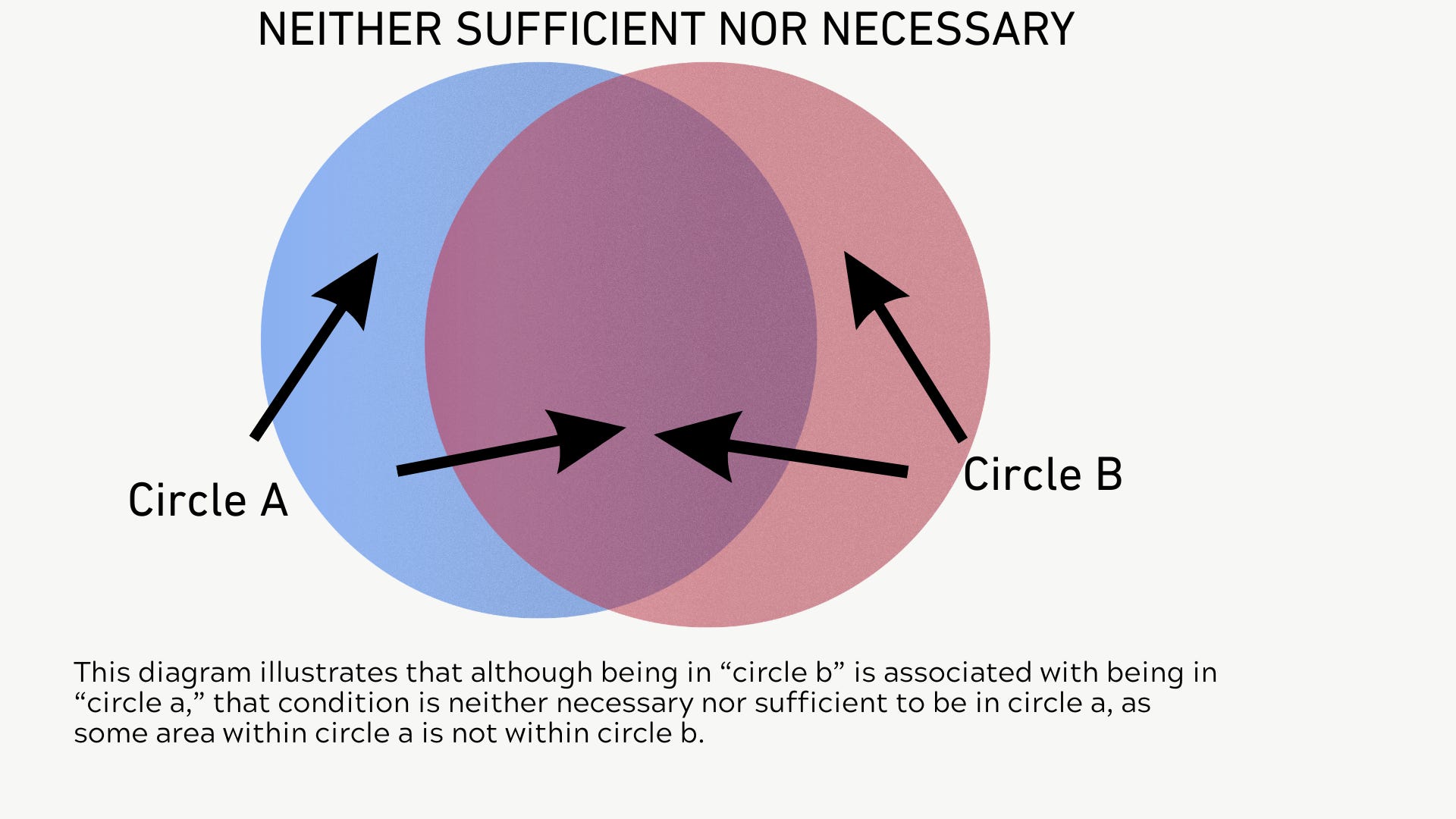
Women are, to a large degree, attracted to male promiscuity—even those who insist they are not. While men seek and desire attractive women, attractive women are not as interested in young attractive men as they desire men who are desired—or are perceived to be desired—by other attractive, high-status women. This explains why the sorority girl interviewed in the New York Times article “The New Math on Campus” recounts that her frat boyfriend has fucked five or six or her frenemies, that she knows of, and does so without the slightest bit of disapproval. In the female, estrogen-laden mind, this is not seen as a liability or cause for concern, but validation. This in turn means that youth, good looks, even favorable economic status are not—by themselves—sufficient to attract desirable women, and it is questionable whether the first two attributes are even necessary conditions in a strict, absolute sense.3

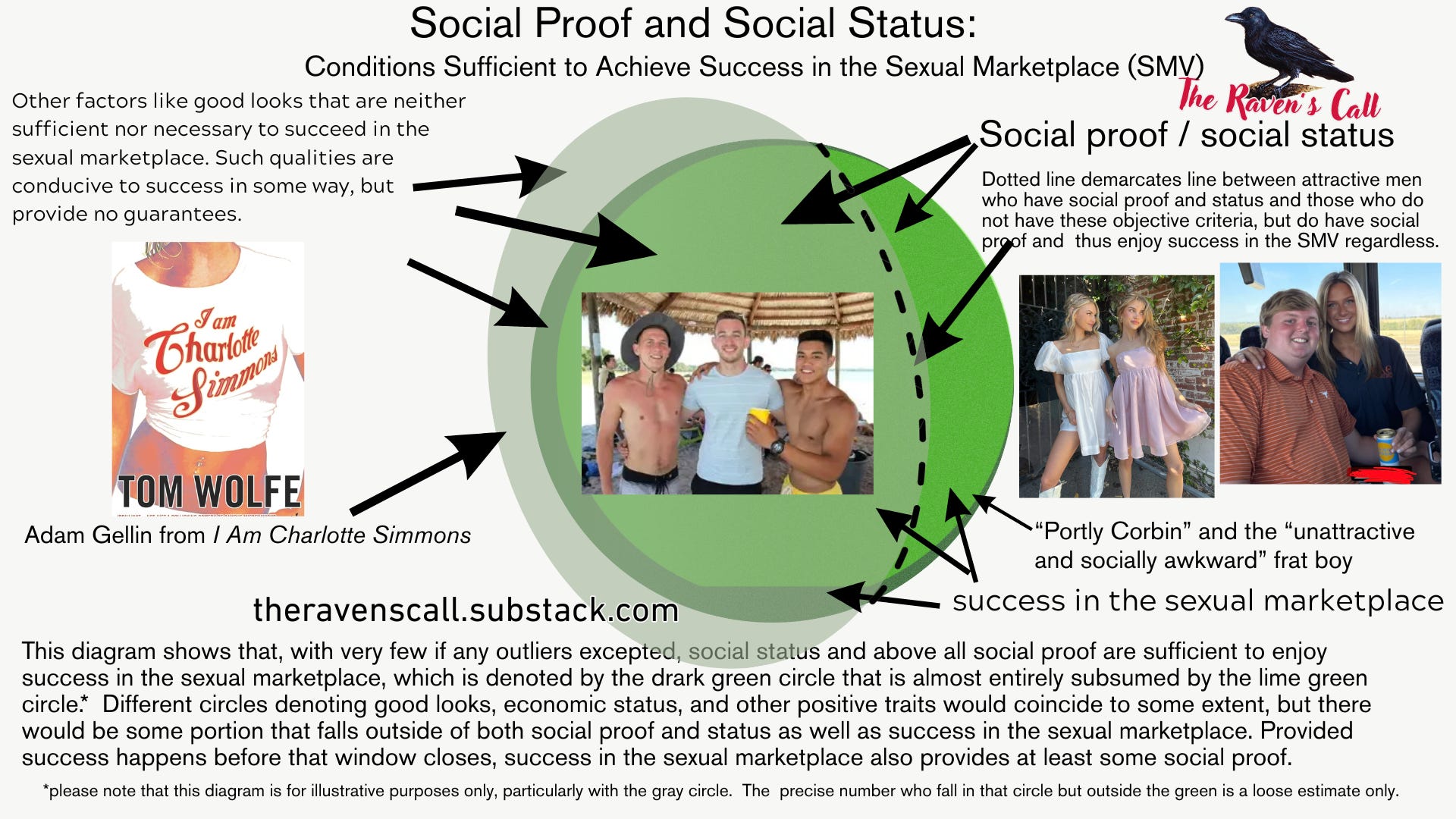
Consider two anecdotes related by Matthews that illustrate this unsettling truth. The first concerns a sorority girl whose friends were “teasing her” for hooking up with a fraternity brother who is “unattractive and socially awkward.” Clearly, the social status associated with fraternity membership superseded what should be overriding negative factors under any sane, rational analysis, a qualifier that seems to be precluded by the female mind. The second is “Corbin,” a “portly but affable” senior who gloated, in relation to a fraternity party, how the fraternity system has gamed the college social scene:
Coming here for the first time, it’s just you, your fraternity brothers, and all of these women. . ..” So many that it’s almost overwhelming. And then you realize: They are all here for you.
As these and many other examples amply demonstrate, the existence or absence of social proof is often and indeed almost invariably a deal-maker or a deal-breaker. A young man could be a veritable James Dean, have attractive facial features and an athletic body, but if he is a social outcast or a loner, or lacks sufficient social status by, for example, not belonging to a fraternity, he will find that while gay men may look him over routinely, he faces significant more difficulty in attracting women, simply because other attractive women are not observed to be fawning over him. This in turn reveals what a terrible idea it really is to forfeit sex and dating through much of one’s twenties. Indeed, one can scarcely think of a better means of self-sabotage and personal ruin than this.

In a young man’s youth there is a small window to obtain such social proof, starting when youngsters are too young to be having sex (but have been having sex anyway for decades) at about 14-15 through high school. That critical, make-or-break window of opportunity is constricted but remains somewhat open to about 19-20, i.e. the first year or two of college. After that point, being a virgin or having less than optimal experience in sex and dating, to the extent young people still date at all in the age of “hook-up” culture, becomes a liability in attracting and meeting young women. And the longer that state of affairs continues, the more of a liability it becomes. In this way, encouraging or suggesting young men to undertake a decade or more of celibacy is the worst possible advice to give young men. That admonition pertains to both gurus and other sorts who advance age-gaps in relationships in effort to game “sexual marketpalce value” as well as the more rigid, unyielding expression of Christian and other sorts of prudery.
In addition to being a sure-fire way to repel most women, these foolish ideas beget other problems. Sexual intimacy is a psychological and even biological need. To expect young men to run the gauntlet through their entire young adulthood, i.e. late teen years through much or even all of their twenties, is antithetical to human nature and a healthy male sex drive. There are few conditions more likely to beget deep unhappiness, isolation, neuroticism, and much worse besides.
It is likely such a sexual embargo begets other disadvantages in life as well. The psychology racket currently seated in this ideologically corrupt and intellectually hallow university system would be unlikely to ever conduct a number of studies to prove this, but consider this most persuasive hypothesis. Young men with sexual experience, who are desired by attractive women, in no small part because they are desired by other attractive women, often do much better in life in other aspects, including professionally. Imagine a study with two control groups, one with the men who have dating and sexual experience during those critical time periods, and those who have, either by choice or involuntarily, run the gauntlet of prolonged, indefinite celibacy through much of the 20s if not into their early 30s. Which control group fares better with on-campus interviews (OCIs), either in four-year college, or in the post-graduate context of law school, masters in computer science, business school, medical school, and so on? Which control group is afflicted with a greater statistical likelihood of not making the run of four or five years through college or, with post-graduate education, six, seven, or more years, because of emotional breakdowns or other problems? Indeed, barring such catastrophe, the second control group may simply not perform as well merely on account of being afflicted with a sexual blockade while the other is not. While some men are presented with inordinate challenges to aver such a crushing, catastrophic liability, it is an affront and outrage to not encourage young men to avoid such debilitating circumstances.4
It should be noted that most who are proffering this absurd idea are not typically the ones expected to run this excruciating gauntlet. Much of it is just so ridiculous. Few if any are anything close to the sort of Lothario that Leonardo DiCaprio is. Nor do most come even close to comparing to a former, has-been “alternative” rock-star like Kiedis or a retired actor who made bank from the Spiderman movies during the turn of the millennium. The cringe-inducing memes and associated rhetoric allows these men to live vicariously through this wanton, profligate womanizing. On the other hand, those who do gain a personal benefit are not typically the sort who has remained celibate into his late 20s, mid-30s or even 40s before being paired with a teenager or young woman in her early twenties. While in no way equaling the notorious exploits of the worst sort of womanizers such as Leonardo DiCaprio, many of these men were the frat boy types who accumulated quite a few notches on the proverbial bedpost, just as many have already been married and divorced and now want to poach the dating pool that should be principally reserved for the succeeding generation of men. This consideration reveals the plundering and corruption of the younger generation of the women that much more of an outrage.
None of this is to suggest that either the state of young women, especially the zoomers and alphas, is anything close to ideal, let alone tolerable. But these ideas only worsen the matter. Certainly, the sexual marketplace as experienced by most young men is daunting, for many of the reasons set forth in this essay and with even greater detail in “Culture and the Sexual Marketplace.” But suggestions such as these provide no solution whatsoever, either to society or the individual.
Sound But Controversial Advice For Young Men
One bit of sound but in some ways unsettling advice to young men, particularly those men with more idealistic, romantic sensibilities, is to relent to the promiscuous sexual mores of our time. This circumvents the unrealistic expectation and sometimes even the unfortunate reality of prolonged, indefinite celibacy. If an otherwise idealistic young man partakes in certain sexual comforts, certain tawdry dalliances with a woman (or two or three) who is less than ideal and that he does not regard as suitable for love or marriage, this will ultimately provide him that critical element of social proof, of preselection, that is vital for him to ultimately build a relationship with a more suitable woman. “More suitable” is the operative language, as fewer and fewer young women come anything close to ideal with each succeeding generation, and that is no truer than now in this modern age where love, honor, and beauty have seemingly died in most facets of our sick society.


Many readers will balk at this, most especially those who object for religious reasons. Any sensible person must however react to the situation as he finds it and consider the “facts on the ground” as they are. Admittedly, such stop-gap measures do not advance the objective of improving social norms and mores on a macro, sociological scale, but nor does encouraging young men to entertain the mad folly and delusion of prolonged, indefinite celibacy.
A key, fundamental distinction between this recommendation and the classical “plate spinning” advocated by various gurus in the manosphere cannot be emphasized enough. Tomassi and others expressly disclaim considering any possibility of a serious relationship, and do so well into one’s thirties. This model, on the other hand, advises young men to always be open to a more romantically ideal, long-term relationship geared toward marriage, but to be open to other dalliances and forays until such time such an opportunity for a serious romantic relationship presents itself. It must be cautioned, however, that, in this day and age, such opportunities may never come.
This of course is not ideal but, provided the woman in question is not so skeevy as to preclude sexual arousal, and provided that her appearance and aura do not negate the social proof procured from such dalliances, either by being just flat out unattractive if not repulsive or strongly suggesting any number of serious and intractable venereal diseases by her manner and presence, it is a much better solution than the alternative.
This controversial assertion must further be qualified by another assertion, namely that such advice is different for men than it is for women. Because promiscuity for men is fundamentally different than it is for women, this allowance should only ever apply to men. Women are not stigmatized for chastity, celibacy (either on a voluntarily or involuntarily basis), or less than optimal success in the sexual marketplace. Men are mercilessly stigmatized for such circumstances. Although rare, there are some outliers of attractive women outside the mean girl, sorority sister, princess complex type that predominates much of white womanhood in America and the greater Anglosphere at large.5 Before the advent of birth control, abortion and modern medicine reducing the number of deaths associated with complications in pregnancy and child birth, sex always had much higher costs for women than for men. And even with such advances and innovations, sex still does impose a higher cost, by way of asymmetrical risk in contracting venereal disease, the risk of violence against women by the worst sort of men, and less desirability as a potential long-term girlfriend or wife that accompanies higher “body counts.” Finally, as most readers are well aware, there is no real challenge for all but the most unattractive women to find sexual partners, whereas men play the sex and dating game on a much more demanding “difficulty setting.”
While women are generally attracted to male promiscuity (see once again the sorority girl from “New Math on Campus)” men generally are not. And while it is unrealistic in this day and age to expect a “white wedding” in many segments of American society, eventually a woman, despite being quite alluring physically and sexually, passes a threshold with past sexual partners that becomes at first off-putting, and then down right revolting. A woman who has had multitudes of sex partners, sometimes a hundred or more, would compel most men to think long and hard about whether they would want to kiss that mouth, or whether to even stick it or lick it, with or without a condom. For these and other reasons, this recommendation, although far from ideal, is fundamentally different for young men than it is for women.
Restoring Balance in The Sexual Marketplace: The Prime Directive
Nor does this recommendation discount how difficult prospects are for all but those men who are born into certain advantages by way of family and wealth as part of the “rich kid, frat boy” problem discussed earlier. Elements in the culture encouraging any number of vices and destructive behaviors have tainted and ruined a critical mass of otherwise alluring, desirable young white women. These range from not just promiscuity but hyper-promiscuity, the attendant normalization and encouragement of so-called sex work, from traditional pornography to the veritable pariah that is OnlyFans and other such sex cam sites, to the rise of escort work and even “sugar daddy” websites where young women are paired with wealthy men in a thinly veiled pay-to-play scheme. The proper response is not to worsen the dire state of the sexual marketplace by compounding competition by encouraging older, generally more wealthy men to compete with young men who are trying to make a go of their lives. The prime directive must be to restore balance between men and women, create and restore a set of social norms and mores where white men and women desire each other once again free of most of these pernicious social influences and trends. Encouraging men in their mid-thirties and even into their forties and beyond to “date” young women and crowd the dating and sexual marketplace is antithetical to that prime directive.
PLEASE NOTE: Readers who enjoy this essay are asked to press the “like emoji” to signify their favor and share with anyone who would find this insightful, interesting, or provocative. Follow Richard Parker on twitter (or X if one prefers) under the handle (@)astheravencalls. Delete the parentheses, which were added to prevent interference with Substack’s own internal handle system.


The Princess Complex:

Author’s note: readers will likely notice a cat emoji on the cover image to censor what is likely indecent exposure. An earlier iteration of this collage can be found here. Whether she is in fact fla…
Incel: The Most Mindless, Unoriginal Insult of All

Why does every [woman] do what others do? Can't a woman learn to use her head? …
As Matthews and others document, the ridiculous drinking age of 21 facilitates an unnatural monopoly enjoyed by fraternities in throwing parties serving alcohol. Of critical importance is the “policy held by all Panhellenic sororities that prohibits alcohol consumption inside sorority houses.” The result of this is “that any social get-together involving alcohol (which is pretty much all of them) is displaced to fraternity houses or third-party venues.” Readers can disagree whether this is an unintended or intended consequence of the drinking age set at 21, but this author strongly suggests it is the latter.
On a personal note, reading the Matthews essay, which is essentially an excerpt from her book is infuriating. That college women, including one who attends a higher ranked school are so delusional as to the raison d’etre of the fraternity is confounding. Indeed, one anecdote relates how one young woman discovered, by glancing at text messages on a fraternity member’s phone, that social functions are engineered precisely this way. She stormed out of the parry, reciting feminist “metoo” claptrap. Another essay denoted that college women lament not having a boyfriends for deep conversations and other things typical of committed, long-term relationships, all while doggedly limiting a “dating” pool to fraternity men. Few utterances are as absurd, or more likely to instill the darkest misogynistic tendencies in certain readers.
Note the important distinction between economic and social status. A rich kid who nonetheless suffers from social status is not likely to succeed, as demonstrated by one Elliot Rodger.
Once again, while Tomassi and others encourage “plate spinning,” variants of this general idea expressly contemplate periods of prolonged celibacy, voluntary or otherwise. Part of this is from moral or religious conviction, while another component stems from the simple fact few men can do this successfully, particularly when not even feigning an interest in having a serious relationship.
Indeed, that was a key plot point in I am Charlotte Simmons, juxtaposed with Adam Gellin who had many of the same attributes.
There’s a lot to digest here .
One point , and it may not apply widely , but when I was 19 I lacked control . Such was the testosterone fueled sex drive that reason was impossible for me . Also I came or age “ after the pill but before AIDS “ . 1967-1974 in and around UCLA is hard to describe now . So testosterone filled madness meets wildly promiscuous environment.
One other point . I:finally got married to a woman 8 years younger . We have been married 46 years now. The age difference came with problems . As a woman her life expectancy is longer and especially so in her case due to heredity ( long ) and my family ( short ) . There are other problems .
For many reasons I think Richard is right ..marry someone roughly your age .
I wish I knew this in my teens and early 20s since I am 27 and never had a GF before, and the thought of being too late to experience female affection and happy marriage because I am closer to 30 is depressing.
Didn't help that I followed the wrong crowd for so long like MGTOW, which I reject wholeheartedly. Another reason that I did not pursue relationships was because of being busy with my studies (which is a reason why I wish the school system as we all know it should be eradicated from this World).
I hope being 27 is a second chance at redeeming myself in this regard and I will gladly pair up with women in their 20s and early 30s at most, but maybe I am being blasphemous.
I would not let my future sons go through the information gathering phase as I did.