



Faith in free-market capitalism remains a bedrock of American norms, most especially mainstream conservatism. At issue however is not free-market capitalism restrained and balanced by sensible regulatory constraints and a body of laws that regulates commerce for the common good, but seemingly radical, unrestrained capitalism whereby corporations and the investor class can effectively do as they will. This largely remains true despite an unmanageable regulatory body presently endowed by the federal government. A number of considerations belie such blind faith in this radical free-for-all. Consider how feckless and ineffectual antitrust law and enforcement really is in a nation that tolerates and facilitates the vertical monopoly wielded by Live Nation, or the failure to stop or curtail Amazon and Jeff Bezos from wielding an overwhelming portion of the market share in so many commercial spaces. Banks charge exorbitant ATM fees for a transaction that costs pennies. Printer manufacturers such as HP, Epson, Canon have engaged in unconscionable price gouging. Printer ink is currently sold not only at a higher price than gold per weight by ounce, but by exponentially higher prices. Gold is currently at about $100-105 per gram, whereas printer ink, absent the plastic cartridge, sells between $1000-2600 per gram. That regulatory authorities have not found price-fixing as a precise legal term does not mean it has not happened, even if by the sort of implicit understanding achieved through parallel business models. If antitrust law is unable to sanction such flagrant price gouging, then antitrust and other consumer protection laws need to be reformed so that such price gouging is sanctionable under the law.
High fructose corn syrup and other poisonous food additives are another example that impugns unrestrained, free market capitalism, as it is an example already familiar to many readers of this publication. More and more consumers are increasingly aware of the number of harmful effects of consuming food products laden with the high fructose corn syrup monster, and yet it remains in a surprising number of food products in the United States.1 This distressing state of affairs remains true despite an increasing public awareness of how bad it is. In contrast, while it is technically a myth that high fructose corn syrup is banned outright in the European Union, it is so tightly regulated and restricted as to be effectively banned: a de facto rather than a de jure ban. Sensible, effective, and, indeed, necessary food and drug regulations protect the European populace from this pariah; unrestrained free market capitalism has not. Detractors will of course object that the ubiquity of high fructose corn syrup stems from the lobbying efforts of Archer Daniels Midland which persuaded the United States government to impose sugar tariffs so high that the artificially processed sweetener is cheaper than sugar. This combined with lavish corn subsidies are what make the ubiquity of the high fructose corn syrup monster possible. Libertarians aver that this shows the danger of government. To the contrary, the problem lies in a government beholden to corporate interests that allows such entities to engage in what is effectively bribery by another, more euphemistic name. Prohibit such corporate activities, and problems like the government raising sugar tariffs and funding corn subsidies at the behest of corporate interests go away very quickly.
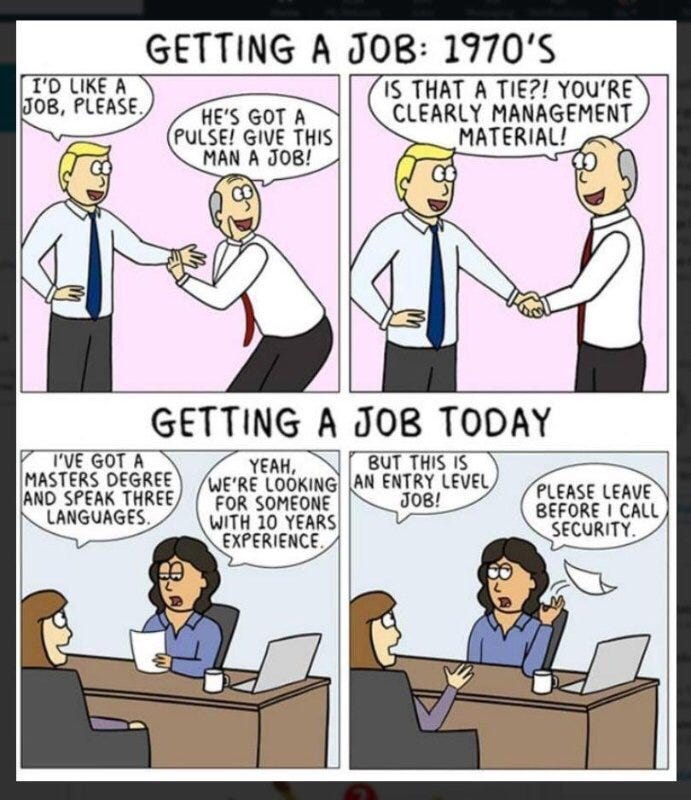
Another example that impugns such faith in free market absolutism relates to many of the hiring processes that characterize much of the labor market in the United States, and, just as importantly, how the process of job hunting has become an unbearable ordeal for far too many. It is these practices that are also the focus of the essay, particularly as these abuses have only grown worse in the absence of a regulatory response. As many readers well know, the United States and indeed the world is in the midst of a slow-burn economic calamity that traces its origins to absurd Covid policy that destroyed between one third and fourth of all small businesses and unleashed trillions of dollars of inflationary spending unprecedented in the first world. This economic reality has been largely diminished or even lied about by the mass media, particularly during the 2024 Presidential election as part of a bid to prevent Trump from winning the Presidency after four disastrous years of the Biden Administration. This of course stands in a large context whereby millennials and Generation X have been afflicted with three such “once-in-a-lifetime” economic calamities: the 9/11 terrorist attacks compounded by the Enron and Worldcom securities fraud scandals in 2001 and 2002 and the Great Recession—actually a depression—in 2008 which dwarfed the prior economic disaster considerably.
Hard truths about this economic reality are exacerbated and worsened by a number of obscene screening and hiring processes and policies embraced by more and more employers. The free market model of course has failed to address such grievances, demonstrating once again the need for sensible regulation. This obvious truth has of course been exhibited in history before, namely the fights and battles against moneyed interests and their abusive practices toward and even outright crimes against the white proletariat. If left to their own devices, moneyed interests will engage in such outrageous practices as child labor, 60 plus hour weeks at a wage that barely sustains a living, and practices even more barbaric. While there certainly must be a balance between labor unions and management that has rarely been exhibited in American history, labor unions fought to end truly barbaric practices by the moneyed interests that existed in those eras. And it was not free market capitalism that led to these changes, but populist revolt coupled with a strong, federal regulatory authority, beginning with Teddy Roosevelt’s progressive reforms. This era broke monopoly trusts like Standard Oil, as well as the greater fight against predatory laissez-faire capitalism. Another important reform was the Pure Food and Drug Act of 1906, which put an end to unscrupulous actors placing poisonous adulterants in food and drug. Some of these adulterants included placing sawdust as a filler for coffee and other products, borax to mask the bad flavor and smell of spoiled milk, brick dust and residue as a filler for cinnamon, and so on. Later, in the post World War II era, the thalidomide tragedy once again demonstrated the need for regulatory controls and oversight, as it ushered drastic regulatory reforms both in Europe and transformed the Food and Drug Administration for the modern age.2



These same problems are present in these times, just in a different, somewhat more benign form. The outrageous practices embraced by an increasing number of employers are considerable in number. One practice that merits regulatory oversight is the practice of posting classified advertisements on job boards like indeed.com, linkedin, and others when there is no such position under consideration. Some instances indicate that as many as one third of such postings are made with no actual intent to hire anybody. These advertisements are placed to harvest resumes, to place feelers for the state of the labor market, as well as to harvest data more generally. This is nothing short of fraudulent, and, since private actors refuse to abide by even bare minimum standards in decency, such practices must be addressed through regulatory and legal reform to prevent such practices and to compel these actors, by the force of law, to act with minimum decency.
This practice would not be so terrible but for another development in the hiring and screening process: a development arising from the advent of resume screening software. Because of this software, increasingly few employers actually read the resumes submitted by applicants. Instead, human resources departments and hiring committees run resumes through various resume screen applications that match resumes according to key words and phrases. This practice effectively requires job applicants to undertake the absurd, unpleasant, and often fruitless task of editing and even rewriting a resume for each and every job posting. This reality multiplies the work involved in the job search by some order of magnitude. It also substantially increases the likelihood of some errant typographical error—hundreds if not thousands of small revisions to a core resume rather than having three or four variants. Obliging applicants to do this is made worse by the substantial volume of classified advertisements and job leads with false leads that bear no actual promise of getting hired. The free-market that mainstream conservatives and libertarian simpletons continue to trumpet about has failed to curtail or ameliorate what is effectively a fraudulent and deceptive practice (false posting of non-existent job openings) and an undue burden on those seeking jobs. Sensible regulations that prohibit and sanction such unsavory practices are thus necessary. There should also be some regulation or oversight in the abuse of resume application software so that job applicants are not afflicted with hours of pointless busywork customizing and editing a resume with key words and phrases, often for a listing or lead for which no opening actually exists.
Another odious practice pertains to the interview process. Instead of one initial interview and one call-back interview in a couple weeks, an increasing number of employers have dragged out the process along a timeline of months. This practice is known as the “marathon interview.” This trend originated from Google and was soon followed by Apple, Facebook (now Meta), and a couple other big tech giants. Exhibiting man’s conformist, herd mentality and nature, many employers—perhaps even most—followed suit. And they did so even though the vast majority of employers do not compare with employers like Google, which is one of the most sought-after employers in that or any field. When such practices are embraced by a large number of employers, it disadvantages job seekers tremendously, particularly those who do not have six months’ or more of savings to live off of while job hunting. This increases the leverage employers have vis-à-vis job applicants, and renders them more likely to accept “low ball” job offers that pay less than would typically occur in the absence of such leverage. This is yet another unsavory, harmful hiring practice born from the so-called free-market. Such practices must be regulated and sanctioned with fines and other penalties. One possibility is to simply require employers above a certain threshold in headcount and net expenditures to pay applicants for any time beyond a second-call back. Even that simple proposal would lead most employers to rediscover how to screen and interview applicants with one initial interview and at most one longer call-back interview.
Would-be employers waste the time and labor of applicants in other ways. An increasing number of employers are requesting—that is, requiring—applicants to complete a take home assignment for evaluation. There are many indications such projects can require several hours of work, sometimes eight, twelve, or more. Those of a more cynical persuasion aver—correctly—that this is nothing other than a labor extraction scheme, whereby would-be employers are able to coerce desperate applicants to work for free, often with no real intention of hiring that person. All too reminiscent as to how such entities would engage in horrific child labor practices if they could, these entities engage in these practices simply because they can. The free market has proven utterly incapable of addressing and ameliorating such practices, so they must accordingly be regulated and sanctioned by the power of the state. Any activity other than an employment application and one initial interview and one “call back interview” must be compensated for, with possible exceptions for small businesses. Request a finalist candidate to complete some PowerPoint presentation that requires eight hours of writing, research, and graphic design work? New reforms in employment law require such labor to be compensated for at the higher end of market value for any labor performed.
The same problem presents itself with various aptitude tests and even foreign language tests that can take several hours to complete, with the foreign language tests lasting up to an hour. It is rather shocking that some of these foreign language tests are less than encouraging in their accuracy or utility.3 Even setting aside whether such tests meet even bare minimum standards or the incompetency and ignorance that drives many employers to use such tests without scrutiny, the same principle applies—if an employer cannot get a French or German speaker to get a Fingerspitzengefühl for any given applicant’s language proficiency, employers should be obligated to compensate applicants for their time and trouble.
The abuse of internships further impugns and condemns the labor market under unbridled free market capitalism. Internships are of course (theoretically or marginally) regulated by federal employment laws and their governing agencies. By law, internships by definition are prohibited from bestowing a substantial economic advantage to, for lack of a better term, the employer. The key, defining feature of internship is the educational benefit that is supposed to be bestowed on the intern. In practice though, that is not how it works. Persons employed as interns regularly and consistently engage in labor that is in no way educational or vocational and bestows a clear economic benefit to the employer. This has led to class action lawsuits, including a more famous settlement with NBC that was using interns in place of entry-level employees. It is noteworthy that many of the corporate entities that engage in such practices wield unimaginable wealth. NBC studios is worth about $45-50 billion, its parent company as of 2026 between $140-150 billion and yet engages in such niggardly behavior despite being more than able to pay a fair and reasonable sum for labor performed.


Even worse, because players in the marketplace have embraced the experience paradox, whereby years of experience are required for even entry level jobs, college graduates or soon-to-be college graduates are effectively beholden to the internship fiasco. In addition to the obscene expectation that college graduates and others work for free up to a year, unpaid internships are often in some of the most expensive cities in the nation and the world—New York, Washington D.C., Los Angeles, and so on. The left of course is to be condemned for its false postulations about white privilege, but there is a kernel of truth in the abstract, provided one supplants “white” with “class.” In order for a college graduate to play the internship game, a living allowance is required, invariably from a well-to-do family that can pay a year’s living expenses while working for free. Whites are doubtlessly over represented in this class, but many more middle and so-called “working class,” that is lower-middle or proletariat class of whites cannot. Of far greater interest to many readers of this publications, Jewish families are wildly are overrepresented in the number of persons that can afford to support a college graduate in this way—and yet so very few dare to mention these realities of Jewish privilege, wealth, and power.
So-called free market capitalism, once again, has failed to ameliorate this problem, or the institutional aversion to training potential hires for what is in effect an entry level job. Once again, sensible regulations will have to be imposed to get these monied interests to do what is necessary for the common good. And that is proven by our counterparts in the European Union and the United Kingdom. Great Britain has regulated unpaid internships, and requires minimum wage for internships that can be qualified as work. France has limited them to two months. Germany has limited them too, requiring payment after three months.
Finally, consider two other practices embraced by employers, until mostly “blue states” passed laws rightly banning them. Employers routinely demand, or did demand. a credit check, even for jobs that do not involve a fiduciary duty to an employer or client. How do these employers, in their infinite wisdom, help those in tough times help themselves? Deny them a job that would allow such individuals to pay their bills and rent. Even worse, employers started demanding social media profiles, even profiles that are quasi-anonymous. It is unclear what the response “I do not use any social media” would likely do to a prospective applicant’s candidacy, but given how fickle human resources departments and hiring committees are, one imagines it likely disfavors such candidacy to a crushing degree. And it would do so even though such social media postings are wholly unrelated to the work an applicant would do—provided someone does not use his real name or has such poor “opsec” to give away such an identity all but the dumbest and most foolish.
Critically, New York banned employers from such information in March of 2024, even though the same state government wants such information to apply for gun ownership, in flagrant violation of the Second Amendment and recent Supreme Court precedent on such matters. Notably, red states like Idaho, Oklahoma, and others have not promulgated such sensible measures. New York was also the 11th state to rightly ban credit checks unless a job description involves some sort of fiduciary duty to the employer or the employer’s clientele. Those other eleven states are all blue states: California, Colorado, Connecticut, Hawaii, Illinois, Maryland, Nevada, New York, Oregon, Vermont, and Washington. That they are blue states in no way impugns how essential and important such regulatory intervention is, although it does further condemn mainstream Republican leadership.
The rationale proffered by some observers of the labor market is that employers have become exceedingly—indeed, excessively—risk averse to making a bad or even less than optimal hiring decision. Some of the measures outlined above supposedly mitigate that risk, but it is highly dubious whether there is any real correlation between these ridiculous practices and reducing the number of bad or sub-optimal hires. Moreover, these and other developments further reflect a macro, sociological trend whereby employers will go to great lengths to avoid training employees. All of this and more is offset by the untold man hours lost by human resources departments and hiring committees administering such ridiculous demands and policies. Such a grind is almost certainly a much greater inefficiency, combined with the lost, underutilized, and in some cases destroyed human capital that has been wasted with such chicanery. In other words, these dysfunctional and harmful practices are a clear example of a market failure, or rather series of market failures. Precisely because the so-called free market has been unable to correct these and other market failures for several decades, regulatory intervention is urgently required.
Some, particularly those of a radical libertarian worldview, will counter that the human resources department which promulgated many of those odious practices arose because of the advent of so-called civil rights laws that obliged employers to come up with some organizational body to monitor and facilitate compliance with this onerous body of laws. This point is not entirely without merit, but the history of labor and employment proves this is not the decisive factor. Large, powerful employers did not engage in child labor or expose workers to hazardous conditions because of Title VII of The Civil Rights Act of 1964. They committed these and other outrages for greater profit, with a view of workers as expendable.
Consider how dubious a key, central assumption of much of the economy theory that justifies the license for moneyed interests to do as they will, namely that every economic transaction and indeed all human interactions are done on a rational basis. Both people and institutions composed of people are not the rational actors that such economic theory presupposes. That so many employers have followed the lead of Google and Meta regarding the so-called marathon interview phenomenon is part and parcel of the sort of conformity and mirroring that typifies a great deal of human affairs. The human resource department is, of course, archetypically a uniquely gynocentric phenomenon, as it is a profession dominated by women, often single women, with a few effete and even homosexual men mixed in. Helen Andrews confirms this:
It is no accident that women dominate H.R. Three-quarters of all H.R. professionals are female, a ratio that has been stable for at least thirty years. The “H.R. lady” is not just a stereotype. She is a statistical reality.
This explains why the “coomon thread uniting” the Human Resources Department as a sociological and corporate phenemonen “is they they are feminine.” Women of course are consensus driven, which explains the acute conformity and herd mentality that defines this phenomeno and the advent of ridiculous applicant screening processes and other harmful practices. Andrews also explains why “rules are ambiguous rather than explicit, as it also explains why “emotions and subjective perceptions are valued more than objective conditions.”
It is also noteworthy that mainstream conservatism has offered no solutions to these problems, and scarcely even acknowledges these and other problems that are harming many millions of Americans, particularly young Americans. This, in combination with other missteps, including a callous disregard for those trapped and even ruined by the student loan crisis, is a fundamental flaw of mainstream conservatism. If left unaddressed, it will—with absolute, mathematical certainty—contribute to the pending victory of the left, which is oh so very close to regaining power and consolidating power beyond the point of no return by returning to open borders lunacy and the infusion of democrat larvae through the importation of black and brown hordes. If mainstream conservatives and the more dim-witted among its natural constituency do not cease with such mad delirium, if these elements persist in telling disenfranchised young people and others to, as Kevin DeAnna described it, not only “eat shit,” but “enjoy it” as well, they will turn to the left, regardless of how flawed and dangerous the left is on other important matters.
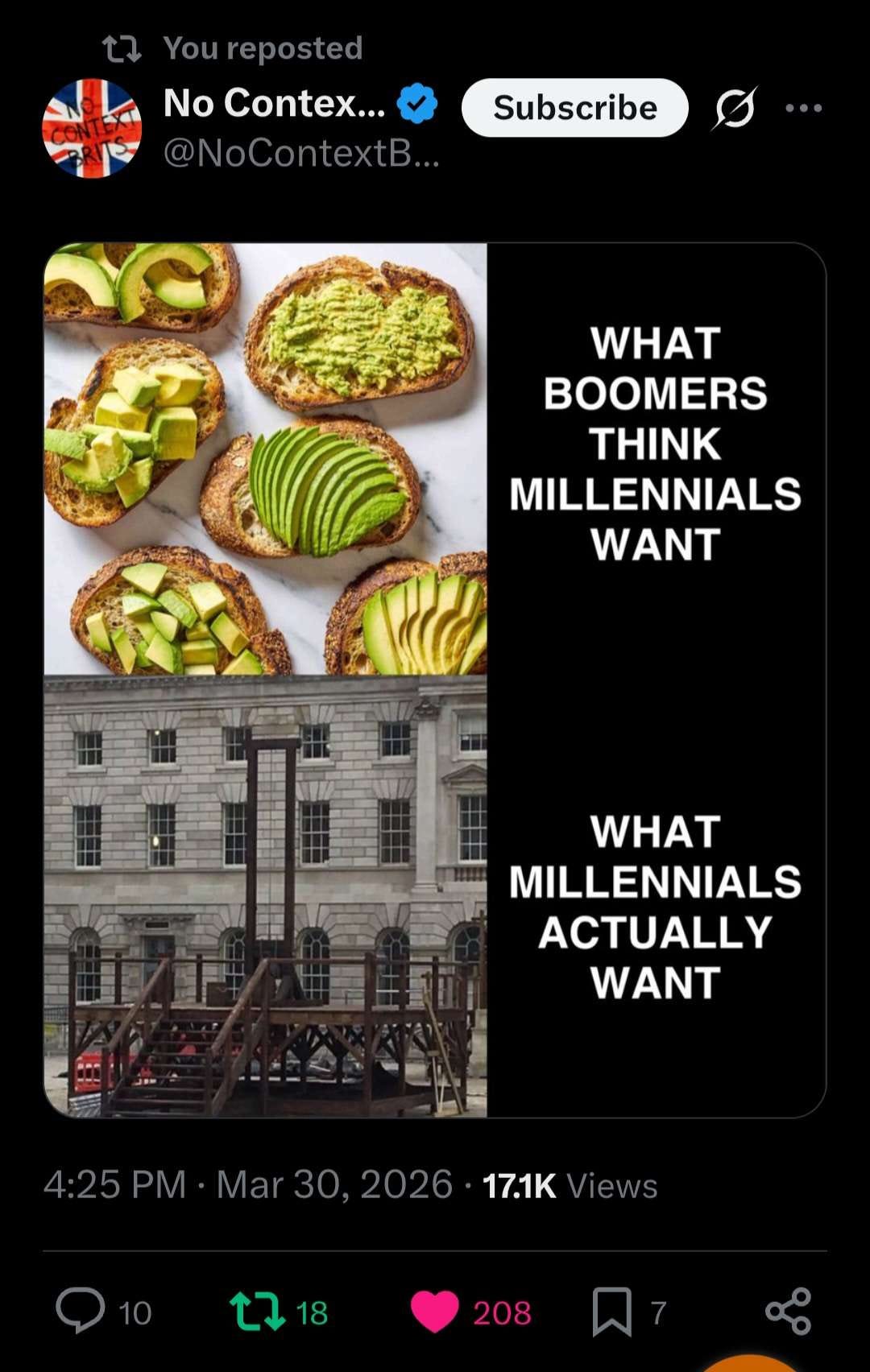
Libertarians and Reagan conservatives will of course balk, countering that the federal government is massive, and that “the nine most terrifying words in the English language are: I’m from the government and I’m here to help.” For a very brief period of time, and without the advantage of hindsight, there was good reason for these ideas to be persuasive. Over the past quarter of a century, however, the American and world economy has oscillated between economic malaise and “once-in-a-lifetime” economic calamity, as outlined above. Some of that is attributed to lack of regulation and oversight. Some of it is also attributable to bad government policy, e.g. the home mortgage bubble that was predicated on government incentives to loan to persons who should not qualify for a loan. Even so, faith in free market absolutism (or fairly close to it) has not addressed these pressing concerns.
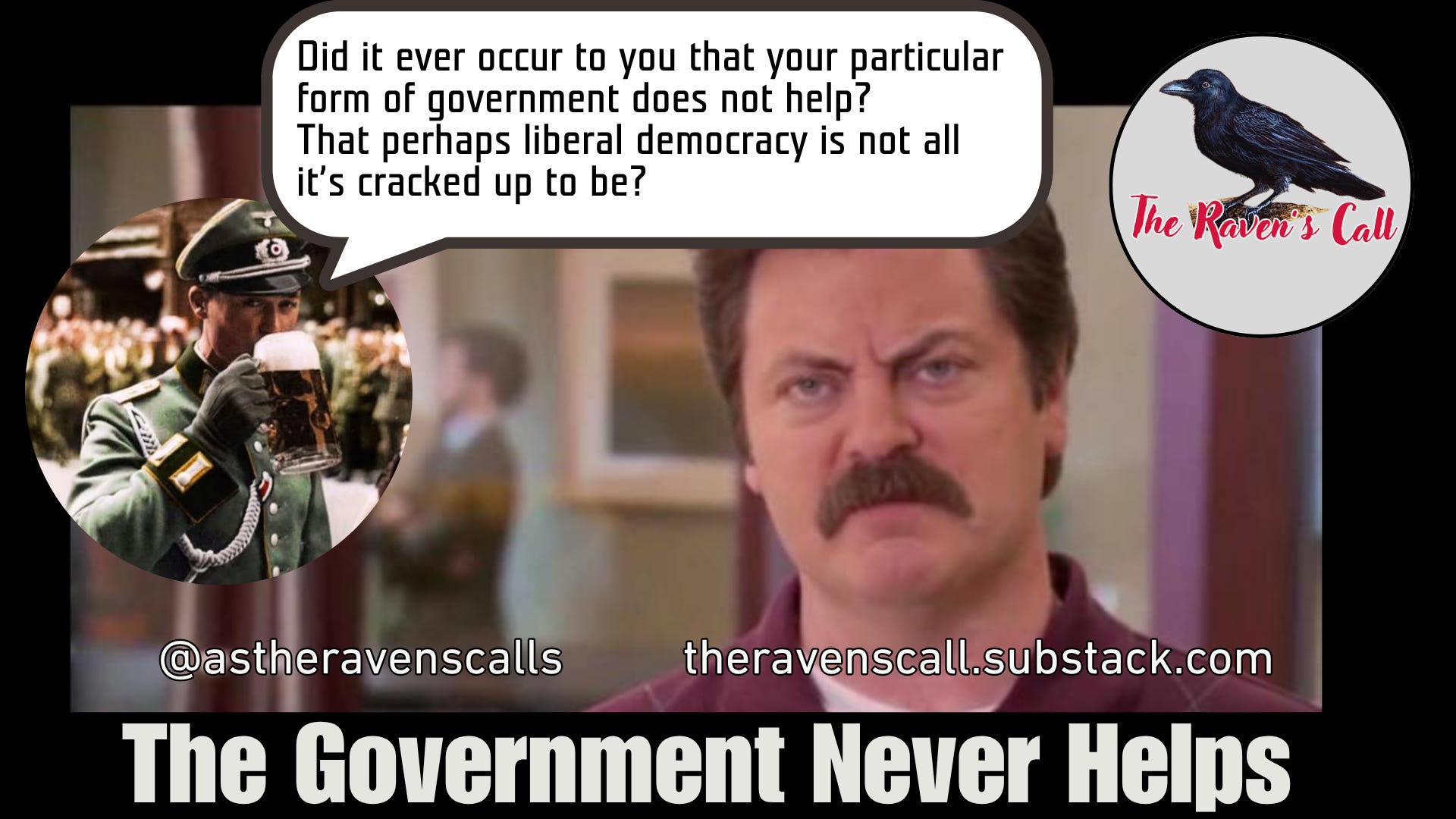
This, coupled with the myriad other failures and dysfunctions directly attributed to American society and more importantly liberal government as well as blind faith in unbridled free market capitalism, implore the need for a different type of government, one capable of facilitating and fulfilling the social contract that exists between the individual, society, and the state. It is not that government—in the abstract—worsens things, or that government alone worsens things. Rather, this type of government, namely liberal democracy bestowing universal suffrage with no meaningful constraints against vulture capitalism and other unsavory and harmful practices both in the labor market and commerce more broadly, is the problem, as it imposes practices that are either ineffectual, counterproductive, or harmful in their own unique, particular way. Such policies are of course exacerbated and punctuated by the myriad dysfunctions and evils of multiracialism, especially as it exists in liberal democracy. The jettisoning of liberal democracy and this particular form of government may be fantastical, at least for the foreseeable future, but so is relying on the good graces and whims of corporations and other powerful, moneyed interests. That axiom holds just as true in the labor market as it does for other pressing issues of the day.
Alas, no such revolutionary moment is anywhere in sight. Some who concede that the American federal government rarely works well—rather than state power in the abstract—will argue that this government is unlikely to promulgate regulatory reforms that are even nominally sensible and effective. Perhaps, but millions of Americans are still harmed by these ridiculous practices. A regularity response, regardless of how imperfect it may be, would at least ameliorate some of these issues, as have state laws banning credit checks and disclosure of social media accounts. Failure to correct these and other matters through state and regulatory power will, as stated, guarantee the appeal of the left among more and more disaffected white persons.
PLEASE NOTE: The eventual success of the publication requires the assistance, pronotion, and support of its readers. Those readers who enjoy this or other, similar writing are urged to subscribe. Free subscriptions are appreciated as they help with increased invisibility, and they of course ensure readers are promptly informed of the latest writings. Paid subscriptions are even more appreciated. Those who can do so without undue burden are urged to pledge their support. This financial support is both appreciated and necessary for the long-term viability of this publication.
As always, readers are encouraged to signify their approval by pressing on the heart-shaped “like” button and to share with anyone who finds this or other writings insightful or provocative.
Follow Richard Parker on twitter (or X if one prefers) under the handle (@)astheravencalls. Delete the parentheses, which were added to prevent interference with Substack’s own internal handle system.
Conservative Dogma and the Student Loan Crisis

An Outline of the Failings and Shortcomings of Mainstream Conservatism
State Power: A Most Effective Means to Achieve Important Ends

“The obligation of subjects to the sovereign is understood to last as long, and no longer, than the power lasteth by which he is able to protect them.” — Thomas Hobbes, Leviathan
The controversy surrounding high fructose corn syrup is somewhat beyond the purview of this essay. One reason why high fructose corn syrup is quite likely to be much more deleterious to public health lies in its chemical structure. Sucrose has an equal ratio of fructose to glucose. High fructose corn syrup however does not have an equal ratio, and can be 55-45 and even 65-35 fructose to glucose. This likely causes a variety of health problems, including insulin regulation (high fructose corn syrup is likely to have a greater propensity to cause diabetes). This imbalance may also dysregulate the body, sending signals that is has consumed glucose when it has not, which intensify cravings. There is also evidence indicating the imbalanced chemical structure is likely much harder on the liver than ordinary sucrose.
It is perhaps (wrongly) still a matter of controversy among some, but readers should be aware that many studies are industry funded, including those asserting that high fructose corn syrup is no different than sugar.
One particularly infamous test, which apparently was withdrawn, was widely prevalent in certain lower dregs of the legal profession. The test took bar exam questions and bar reports from English, and then attempted to translate materials particular to the Anglo-American legal tradition to languages with an entirely different legal system. Native German, French, Japanese speakers routinely flunked the test. This eventually led to a lawsuit by a native Mandarin speaker and an academic paper on the shoddy product. That lawsuit was unfortunately, dismissed, and in case was predicated on discrimination claims. The lawsuit did not center on what should be a tortious harm of evaluating candidates with an utterly flawed, junk “foreign language legal reading” test that native speakers routinely fail. These and other considerations only impugn our legal system further. The test was eventually replaced, but was standard for many years. This and other outrages notwithstanding, employers required untold numbers of prospective applicants to take this test, without compensation, and continue to require other tests with little to no oversight.
While regulatory bodies like the Food and Drug Administration are essential, this should not be read as an endorsement of its many failings since the 1960s. One need look no further than high fructose corn syrup to indict its performance. Another failure is that, in collusion with purveyors of such goods, the FDA has exempted protein supplements and other such products under the absurd rationalization that dietary supplements, which are often used as meal replacements, are somehow not food. That these and other regulatory bodies are in dire need of drastic reform does not prove the blithe assertion proffered by libertarians that they are dispenable or not needed at all.
The conservative establishment has been an unmitigated disaster for working and middle class white people -- personified by the William F. Buckley aristocrats and Israel first Jews.
There was a coordinate attack on the politically powerful well-to-do secure middle-class [old definition] by the government and corporations after the forced ending of the Vietnam War by the middle-class turning against it.
With the killing of the middle-class was the gutting of the heart and soul of the nation.
Here is the article's audio overview mirrored in YouTube: https://www.youtube.com/watch?v=liVz9YpEM7g
".. Crisis of the Modern World, Many Decades of Professional Class Betrayals" https://stevenwork.substack.com/p/multiverse-journal-index-number-2231, https://archive.is/lR0Ky
-----
-- from article --
"The foundational contract of American capitalism—that workers share in the prosperity they create—was severed starting in 1979. From that year to 2024, the productivity of the American worker skyrocketed, increasing by 80.9%. Yet, real wages barely moved, increasing by only 29.4%. Had wages kept pace with productivity, the median hourly wage today would be nearly $40. Instead, it languishes below $20. For the average full−time worker, this statistical gap translates into a concrete monthly loss of approximately $3,543. This is not wealth that vanished; it is wealth that was produced by labor and redirected to capital.
The Inflation Deception
Compounding this wage theft is a systematic misrepresentation of inflation. While the government’s official Consumer Price Index (CPI) reports a cumulative inflation of +188% since 1979, the real-world inflation for essential goods has been catastrophic. Costs for non-negotiable items like housing, fuel, and healthcare have exploded by +300% to +500%. This statistical manipulation serves a dual purpose: it masks a calamitous decline in the American standard of living and erodes the value of savings and fixed-income pensions, ensuring that even what citizens manage to save is silently confiscated over time."